Savings goal calculator

Page updated . Source-review dates are listed separately.

Find out how much to save each month to reach a goal, like an emergency fund, a car or a down payment.

Content updated October 30, 2026 Formula & assumptions explained
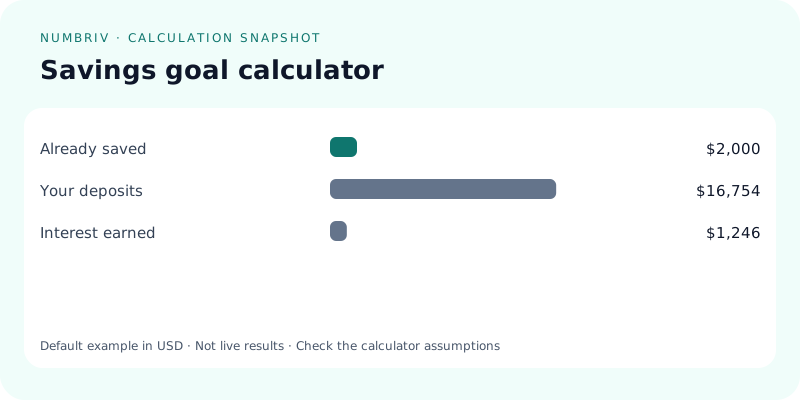
Default Savings goal calculator scenario showing Already saved $2,000, Your deposits $16,754, Interest earned $1,246
Illustrative default scenario in USD. Your inputs change the results below.

Your goal

$
$
years
%
Save each month
$465
to reach $20,000 by Sep 2029
Already saved: $2,000Your deposits: $16,754Interest earned: $1,246From interest6%
  • Already saved$2,000
  • Your deposits$16,754
  • Interest earned$1,246
Per week$107
Total deposits$16,754
Interest earned$1,246

Progress toward your goal

Interest covers $1,246 of your goal.

$0$5k$10k$15k$20kStartYr 1Yr 2Yr 3
GoalBalanceMoney you put in

How this calculator works

Tell us your goal, what you've saved and your deadline. The calculator works out the fixed monthly deposit that gets you there, counting the interest your savings earn along the way.

The formula

PMT = [Goal − Current × (1 + i)n] × i ÷ [(1 + i)n − 1]

i is the monthly interest rate and n the number of months.

Example calculation

You want $20,000 in 3 years, have $2,000 saved, and earn 4% APY.

Interest earned
$1,246
Per week
$107
Monthly deposit
$465.38

Ways to hit your goal sooner

  • Automate it. Schedule a transfer the day after payday.
  • Use a separate account. Money you don't see is money you don't spend.
  • Save windfalls. Put tax refunds and bonuses straight toward the goal.
  • Pick a high-yield account. The rate difference adds up on larger goals.

Frequently asked questions

How big should my emergency fund be?

Three to six months of essential expenses is the usual guide. Aim higher if your income is irregular.

Should I save or invest for my goal?

For goals under about five years, savings accounts are safer. Investments can fall in value right when you need the money.

Is savings interest taxable?

Yes. In the US, interest is taxed as ordinary income, and your bank sends a 1099-INT if you earn $10 or more.

Related calculators

Find planning tools by country and currency. General formulas do not apply local tax or product rules.

Guides for this calculation

Browse every category

Country guides for this calculator

Read the guide for your market; a general calculator retains its own assumptions.

Publisher, sources and review status

Published by Numbriv editorial team. Full jurisdiction/rule review is not recorded as complete. Existing formula tests do not certify every local rule.

Calculation and editorial methodology · Tax-rule review log · Report a correction · Advertising disclosure

How much should I save per month to reach my goal?

With no interest, subtract your current savings from your target, then divide by the number of months remaining. For a $12,000 goal with $3,000 already saved and 18 months remaining, save $500 per month: ($12,000 − $3,000) ÷ 18. Enter your own goal, starting balance, time horizon and interest assumption in the calculator above.

How do I calculate monthly savings goals with interest?

If deposits are made at the end of each month, monthly saving = [target − current savings × (1 + r)^n] × r ÷ [(1 + r)^n − 1], where r is the monthly interest rate and n is the number of months. Use the no-interest formula when r is zero. Interest can reduce the required deposit, but fees, taxes and changing rates can affect what you actually earn.

How can I save each month when the required amount is too high?

Compare a later target date, a smaller goal or a larger starting balance. Check the monthly deposit against your take-home pay and essential expenses. For a short-term goal, avoid relying on uncertain investment returns to close the gap.

Plan a monthly budget · Explore compound growth

Answer content updated October 27, 2026. Calculator rule-review status remains listed above.

Model assumptions and further reading

This tool accepts an effective annual percentage yield (APY), then converts it using monthly rate = (1 + APY)^(1/12) − 1. Deposits arrive at month-end. Other calculators can use nominal rates or different timing, so align those assumptions before comparing results.